

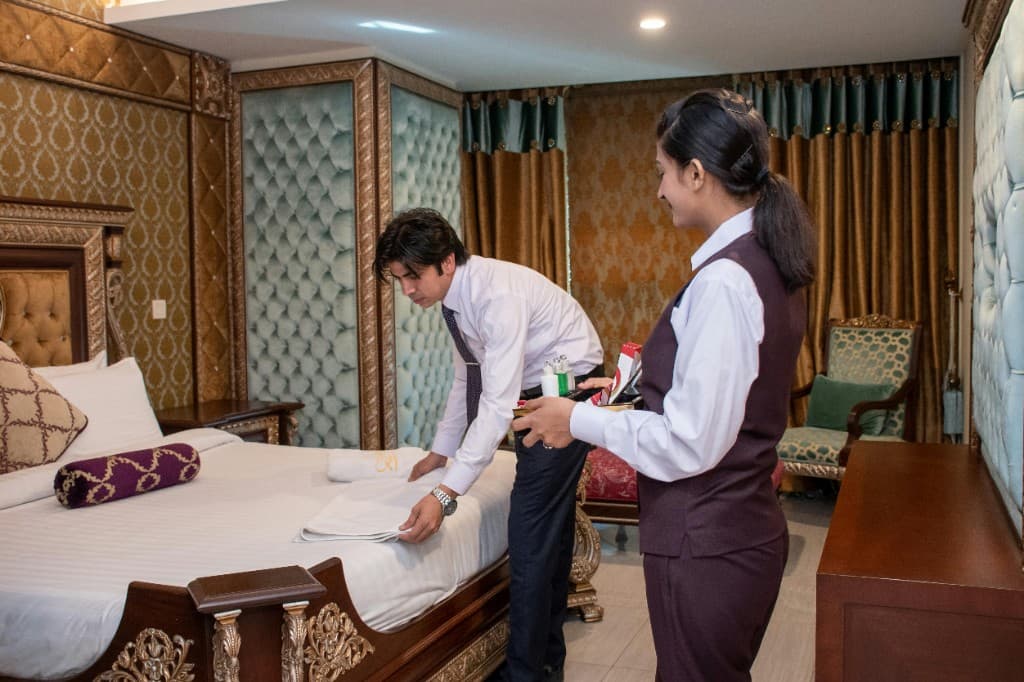
Most people who have worked in hospitality for a few years know the industry in a way that is difficult to pick up anywhere else. The rhythm of a busy service and the small signals that tell you when a team is working well come from being on the floor, not from a textbook. That kind of knowledge comes from the work itself, and experience handles most of what the job demands. What experience does not cover is where studying for an HND in Hospitality Management makes a real difference.
That kind of learning has its own strengths alongside areas where something more structured can add real value. Experience is extremely good at giving you instincts about the floor, the kitchen, the front desk, and the team in front of you. It is less immediate at giving you a framework for the kind of thinking that sits one level above operations. The further up a hospitality career you look, the more consistently that second kind of thinking shows up as an expectation rather than an advantage.
What Years In Hospitality Already Teach You
Most hospitality managers did not plan on learning stock control in detail. They picked it up because at some point you need to understand how the numbers on the monthly reports connect to what is actually coming out of the kitchen. Most of the job gets learned the same way, from scheduling to recruitment and everything else in between, which means practical experience ends up doing a lot of the teaching without anyone having to formally plan it.
Some of the things you pick up fastest working in hospitality include:
- Reading a room well enough to know when a guest needs something before they ask
- Pacing a service so the kitchen and the floor stay roughly in step with each other
- Spotting which staff members will thrive under pressure and which need more support
- Handling a customer complaint early so it stays a conversation rather than anything bigger
- Balancing cost against quality in the small decisions that come up every day
- Building the relationships with suppliers and regulars that hold the business together
These are all real skills, and you learn them well from doing the job. The next section covers the parts of hospitality management that experience alone does not reach as reliably.
Where Formal Study Adds Something Experience Does Not
There is another category of knowledge that working in hospitality tends not to build up on its own, at least not reliably. This is the part that sits one level above the service, where the questions are less about what is happening on the floor tonight and more about what the business is actually doing across a longer stretch of time.
The kinds of things that practical experience alone tends to leave underdeveloped include:
- A structured way to analyse the competitive landscape your business is operating in
- A clear understanding of how your property or operation compares to others in the sector
- The legal and regulatory frameworks sitting behind hospitality businesses
- A working knowledge of accounting past the figures you see on your own reports
- Strategic planning that extends further than the next season
- Research methods for making evidence-based decisions about pricing, offer, and positioning
- The ability to explain your reasoning clearly to owners, investors, or head office
Plenty of hospitality businesses run well for years without their managers formally picking up any of these. The issue is what happens when you want to move into a general manager role, or when you want to take on a larger property, or when a decision comes up that does not fit inside the instincts built up so far.
How A Formal Qualification Fills The Gap
Formal study does a particular job. It gives you the structured knowledge and academic frameworks that experience on its own does not provide, and it does so in a way that applies to situations you have not personally encountered yet. That is a different kind of learning from what happens during a shift, and the two complement each other rather than replacing each other.
The HND in Hospitality Management at LCK Academy is a Pearson BTEC Level 5 qualification delivered in partnership with University Centre Somerset College Group (UCSCG). The course carries 240 credits across two years, and the units are designed to map closely onto the real work of hospitality management at mid-senior level.
The programme starts with an operational and managerial foundation in Year 1, and moves into strategic and specialist thinking in Year 2. The progression matters because the first year gives you the shared vocabulary of hospitality management that you need for the kind of professional conversations that come with more senior roles. The second year opens out into leadership and the larger commercial questions that shape the direction a property takes.
Year 1 (Level 4)
| Unit | Focus |
|---|---|
| The Contemporary Hospitality Industry | How the sector is structured and where it is heading |
| Managing the Customer Experience | The systematic side of what experience teaches instinctively |
| Sustainable Hospitality Practice | Environmental, social, and commercial sustainability in the sector |
| The Hospitality Business Toolkit | Core tools for managing a hospitality operation |
| Leadership and Management for Hospitality | Foundational leadership frameworks in a hospitality setting |
| Managing Food and Beverage Operations | The commercial and operational side of F&B |
| Managing Conference and Events | Events as a revenue stream and operational challenge |
| Professional Identity and Practice | Building the professional identity the industry expects |
Year 2 (Level 5)
| Unit | Focus |
|---|---|
| Research Project | A substantial independent research project worth 30 credits |
| Hospitality Interpersonal Skills | The interpersonal side of senior hospitality roles |
| Food Service Management | Managing food service at a strategic and operational level |
| Front Office Operations Management | Strategic management of the front office function |
| Digital Marketing | Digital marketing as it applies to hospitality |
| Business Strategy | Strategic thinking and competitive analysis |
| Strategic Human Resource Management | People strategy at the level of a whole business |
The Year 2 Research Project is the most substantial piece of work on the course. It carries 30 credits, which is double the weight of any other unit on the programme. Students design and carry out an independent research project from scratch, choosing a question, selecting a methodology, and defending the conclusions academically. For students who have spent years working in hospitality without being asked to produce formal research, this tends to be the unit where the distance between Level 4 and Level 5 becomes most visible in practice.
Business Strategy, also in Year 2, asks students to analyse competitive environments, assess organisational performance, and engage with the kind of decision-making that separates management from operations. That is a meaningful step up from the operational units in Year 1, and it is deliberate. The programme is structured to build toward that level of thinking rather than assuming it from the start.
What A Level 5 Qualification Signals To Employers And Partners
One of the quieter benefits of a formal qualification is how it reads to the people you deal with outside your current role. Level 5 on the Regulated Qualifications Framework is equivalent to the second year of a bachelor's degree, and it is recognised across the UK and internationally as a higher education qualification in its own right. That recognition matters in ways that are easy to underestimate until you need it.
For anyone working in hospitality, the qualification shows up in a few places.
With larger hotel groups and international operators. Internal promotion inside big groups has become more formalised in recent years. A Level 5 qualification signals that you have been assessed against a recognised academic standard, rather than relying only on internal reputation and operational track record.
With general manager and senior operational roles. Job listings at GM and head of department level often specify a Level 5 qualification as a standard requirement. Having the HND removes a barrier that experience alone does not always clear, especially when moving between properties or across brands.
With commercial partners and suppliers. Senior hospitality professionals spend a meaningful amount of time negotiating with commercial partners. A formal qualification gives you credibility in those conversations and a structured vocabulary for the commercial reasoning that sits behind them.
With future employers outside hospitality, if your career moves sideways later. Not everyone stays in the same sector forever. For people who move into adjacent industries later in a career, a Level 5 qualification in hospitality management gives the CV a recognised credential that speaks to the business side of the experience.
With staff and the people you lead. There is also a quieter effect on the culture inside an operation. Staff who see their manager engaging seriously with structured study tend to respond well to it, and it often changes how strategic conversations happen internally.
None of this replaces the day-to-day credibility that comes from years of industry experience. It sits alongside it, and it tends to be most valuable precisely when you are dealing with people who do not already know your work.
What Changes When You Study Alongside Working In Hospitality
People who study while also working in hospitality tend to describe the experience in similar terms. The theory lands differently when you have a real operation to apply it to. Case studies read as comparisons to your own venue, and the frameworks become tools you can test on decisions you are already facing at work. A module on Strategic Human Resource Management, for instance, is easier to engage with when you have actually managed a hospitality team and seen first-hand how the theory plays out in practice.
The other thing that tends to happen is that the course gives experienced hospitality professionals the confidence to stop second-guessing decisions they were already making well. A lot of people who have risen through the industry quietly wonder whether they are doing things the right way. A structured qualification tends to confirm that what they were doing was broadly sensible, while also filling in the specific areas where their approach could be sharpened.
How The Course Fits Around Shift Work
The HND in Hospitality Management at LCK Academy is delivered through blended learning, with online sessions on Monday and Thursday evenings and in-person sessions at the Harrow Weald campus on Saturdays and Sundays. The format is designed for people who are already working in the industry, which matters because hospitality work does not always fit neatly into a typical office schedule.
| Day | Format |
|---|---|
| Monday | Online |
| Thursday | Online |
| Saturday | In person (Harrow Weald campus) |
| Sunday | In person (Harrow Weald campus) |
Assessment is coursework-based across most units, with deadlines published in advance. That lets students plan the workload around the busier periods in their own working schedule rather than being caught out by assessment weeks that coincide with a peak season in their venue.
For students who want one-to-one support alongside the teaching, LCK Academy runs drop-in academic skills sessions and tutorials across the week. The admissions and student services teams also help with Student Finance applications and the wider practicalities of fitting study around everything else going on.
Entry Is Open To People Without A Level 3 Qualification
One of the quieter reasons the HND works well for people already working in hospitality is that the entry requirements recognise work experience as a genuine route in.
Applicants over 21 can apply through the work experience route if they do not have a formal Level 3 qualification. For people who have been working in hospitality rather than sitting A Levels, the required documentation is:
- Two years of P60s
- A current employment contract
- An employment reference
For self-employed applicants, the equivalent is three months of recent invoices, two years of tax returns, and a letter from an accountant or from a client the business has worked with. English language proficiency is also required at CEFR B2, though applicants with GCSEs at grade C or above, or a recent IELTS score of 5.5, are usually exempt from the language assessment.
The admissions team at LCK Academy can advise on which route applies before you submit an application, which is useful if you are not sure whether your background would qualify on paper.
Continuing Into Further Study
A Level 5 HND sits at a point in the qualifications framework where further progression is possible. Graduates of the Hospitality HND who want to continue into a full bachelor's degree can progress to a Level 6 Top-Up at universities that accept Pearson qualifications. The specific route depends on the university and the subject area, and the admissions team at LCK Academy can advise on which progression options tend to work well for Pearson HND graduates.
Who The Course Works For
The HND in Hospitality Management at LCK Academy tends to suit people who are already working in the industry and want to pair their practical experience with the structured knowledge that experience alone cannot provide. It works for people moving from operational roles toward management, and for people already in junior management positions who want the formal qualification to match the work they are doing.
If you are weighing up whether the course would fit your situation, the admissions team at LCK Academy can talk through the options before an application is submitted.
Getting Started
To find out more about the HND in Hospitality Management at LCK Academy, or to talk through how the course might fit alongside your current work, get in touch with the admissions team:
- Email: admissions@lckacademy.org.uk
- Phone: 020 8161 3300